


Qanvas, the AI-native trading workstation for institutional desks
1,000x feature delivery.
Build any trade workflow in days.
Qanvas is the AI-native front end and workflow layer for Quod Financial's multi-asset OMS/EMS, giving trading desks the screens, tickets and workflows they ask for in hours instead of the usual 12 to 18 month vendor wait. AI builds the software while routing, matching and risk stay in Quod's proven low-latency core, so desks get startup speed without putting a single order at risk.
Trading software has changed for good. For decades, trading desks have adapted to their technology. Qanvas reverses that.
feature delivery
merged feature
into production
and digital assets
Imagine a desk that gets everything it asks for.
Qanvas changes the relationship between a trading desk and its technology, from waiting to asking: features, fixes and custom workflows can arrive in hours instead of sitting on a roadmap.
Every function you have ever wanted. Every feature that sat on a roadmap. Every custom workflow your traders built a spreadsheet to work around.
Delivered at a thousand times the speed.
What is Qanvas?
Qanvas is Quod Financial's AI-native trading workstation: a customisable front end and workflow layer on Quod's multi-asset OMS, EMS and smart order router, where a new desk workflow is specified in plain language and can often reach production in hours rather than months.
Qanvas is the ability to change. It is growth for the desk. It is transformation for the business.
It delivers new features to the trading desk immediately, on top of Quod's multi-asset order management (OMS), execution management (EMS) and smart order routing (SOR). It is AI turned into a usable application and a usable workflow. Quod's first production use of AI in how trading software is built.
Its defining characteristic is not the interface. It is the cost of change.
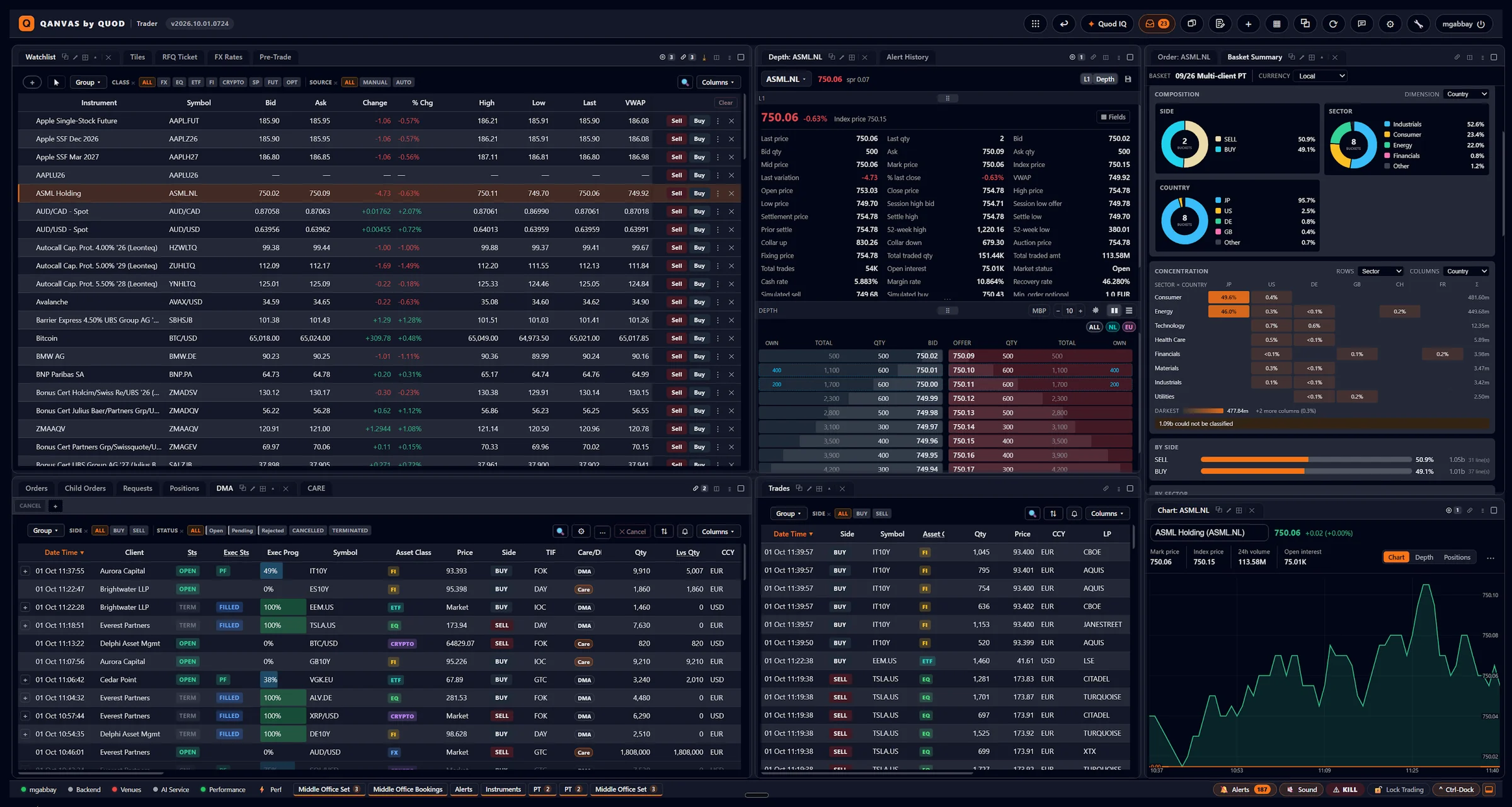
Prompt to production
Qanvas's AI-native architecture takes new features from prompt to production in hours, not months. AI is how Qanvas is built, not a chatbot on a trading screen. Every change is tested automatically before it reaches a desk.
Safe, deterministic core
Execution, routing and algorithmic logic run in Quod's deterministic core: predictable, repeatable and auditable. AI builds the software. It never decides where an order goes.
Beyond OMS and EMS
Qanvas is the workflow layer across order management and execution management. With Quod's core, a desk gets a full multi-asset OMS and EMS that keeps evolving with the business.
Every request joins a queue: why desks wait months for a change
Every request joins a queue: a new order type, workflow or asset class enters a roadmap and emerges months or years later, and the desk adapts to the software in the meantime.
Traders have stopped asking for what they need, because they no longer believe it will be delivered. This is not about one screen or one vendor. It is about how trading software has always been made. Quod has spent more than 23 years shipping thousands of features a year to trading desks, and even at that pace the queue never empties. The desk adapts to the software, and the business waits.
A new order type, a new workflow, a new asset class enters a roadmap and emerges months or years later. By then the opportunity has moved.
Traders switch between separate systems for each asset class and reconcile them by eye. Qanvas brings equities, foreign exchange (FX), derivatives and digital assets into one unified desk.
Most desks are told to choose between speed and stability. Qanvas removes the choice. Quality gates are automated and non-negotiable, and quality improves as delivery speeds up.
When the answer is always next quarter, desks stop asking. The workflows that would differentiate the business are never built.
The practical test
When your desk asks for something new, is the answer measured in quarters, or in hours?
How fast does Qanvas deliver a new feature?
Roughly 50 features per week per engineer in sustained throughput, and one verified production feature from request to merged, validated code in 4 hours 33 minutes.
Qanvas was built against four constraints that had to hold at once. AI-native engineering is the only way to meet all four.
Speed that ships regressions to a trading desk is worthless. Every change passes end-to-end validation and a branch preview before it reaches a desk, and quality is never traded for pace.
The desk stays fast however quickly the codebase changes.
Traders judge a screen in seconds. Velocity is never bought with a worse one.
Days, not months. Weeks, not years. Anything less does not change how a desk works.
Roughly 50 features per week per engineer, against a process capacity above 1,000 per week.
One production feature, from request to merged and validated, in 4 hours 33 minutes.
The question stops being "when can you fit this in" and becomes "what do you want the desk to do".
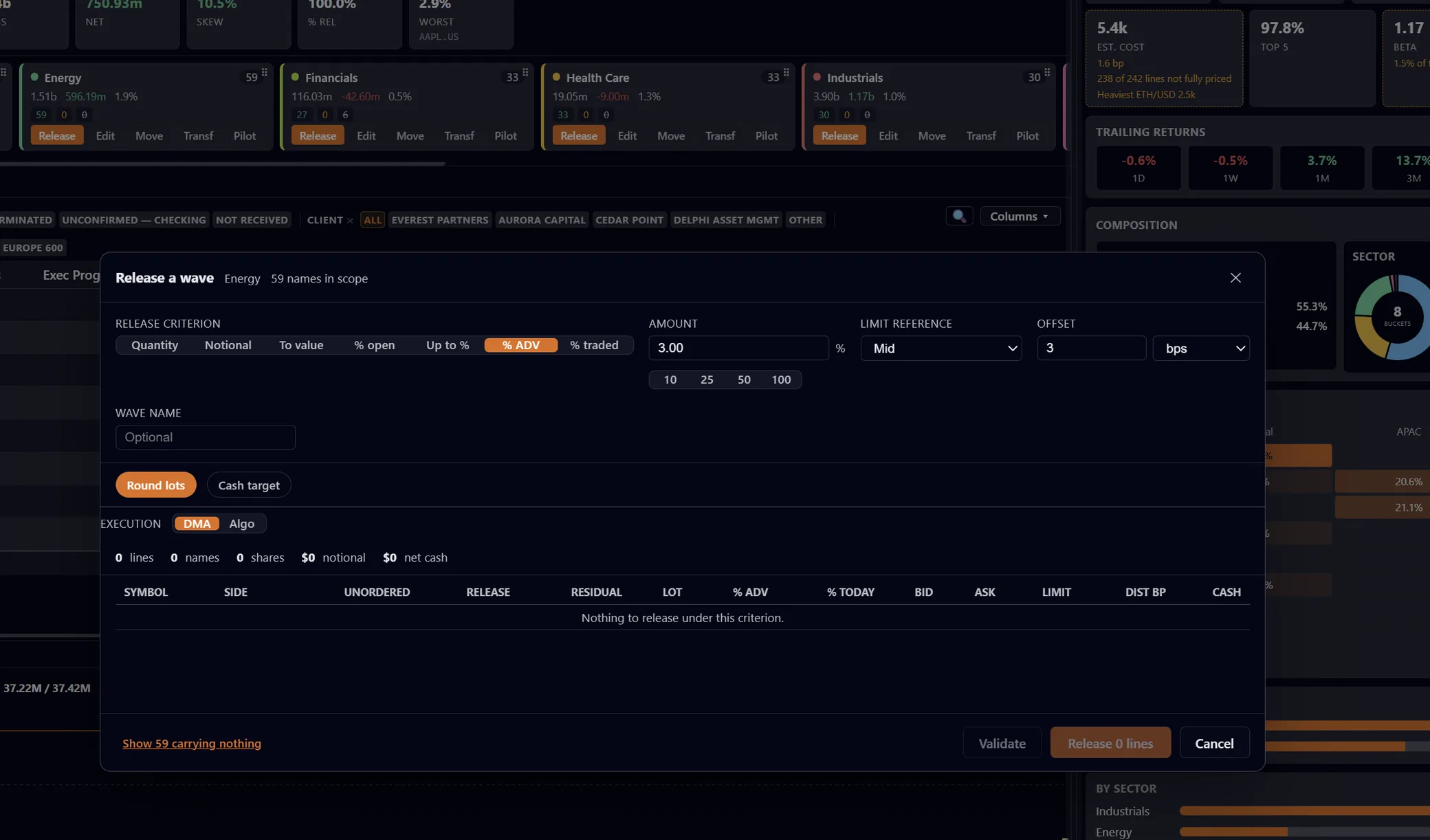
Deterministic core, mutable edge.
Qanvas is the presentation and workflow layer: it holds no matching, routing or risk logic of its own, and order state, market data and execution decisions live in Quod Core.
Qanvas connects to them over Quod's internal message bus.
Advanced headless REST API
One interface to every service on the platform. Build on Qanvas, extend it, or run your own interface on the same core.
Live state streams to the desk with no polling. Blotters, ladders and montages update the moment the core does.
High-performance delivery built for global implementation, with market data storm protection so volatile opens stay responsive.
The execution path stays stable and testable. Workflow and presentation change daily in Qanvas, so delivery speed carries no execution risk.
Every change passes automated end-to-end validation and a branch preview before it reaches a desk.
What Qanvas adds on top of Quod's OMS and EMS
Continuous delivery of new features and workflows, one desk across equities, FX, derivatives and digital assets, charting inside the trading workflow, third-party integration, and alerting described in plain language.
Qanvas runs on Quod's complete multi-asset OMS and EMS. These are the capabilities it adds on top.
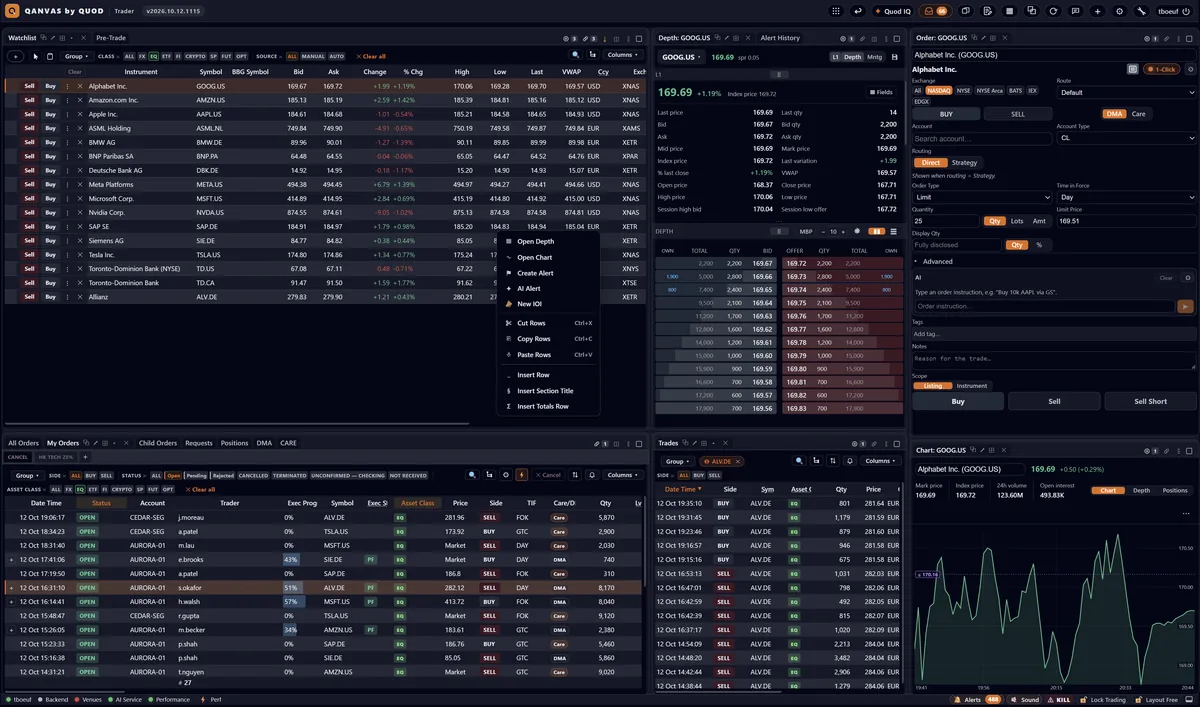
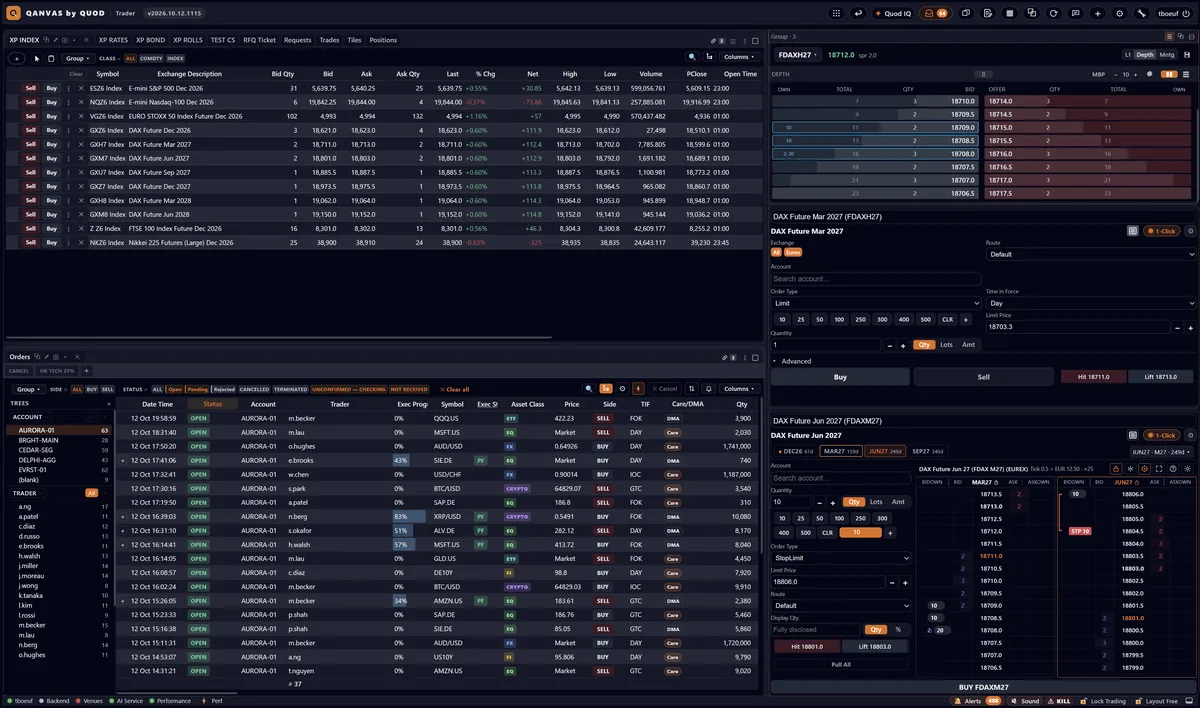
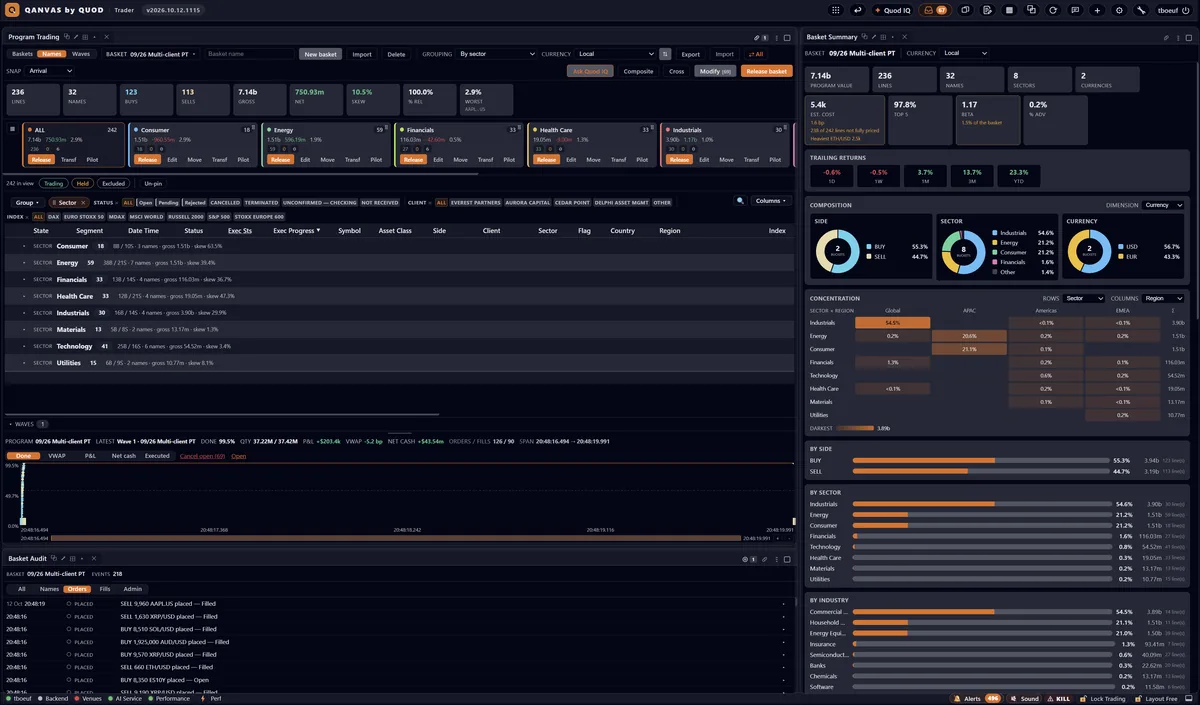
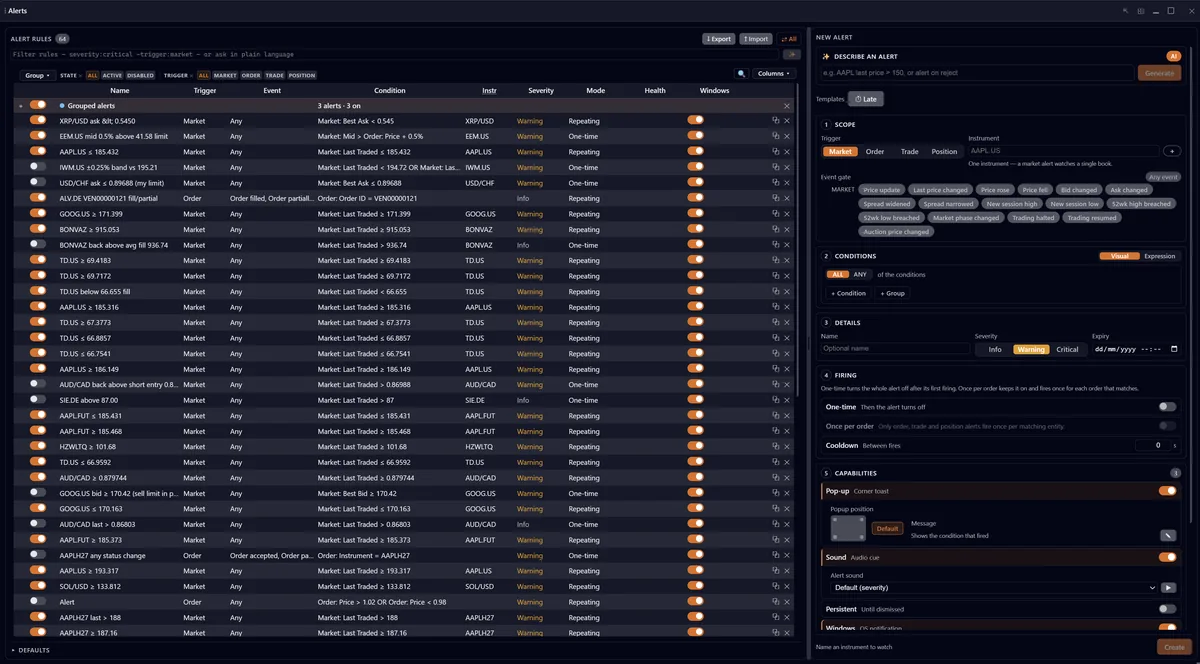
Anything missing? Build it 1,000 times faster.
Ask for it now. In production in hours.
How can a firm adopt Qanvas: product, framework or backend?
Three points on a spectrum of control, not separate products: Quod builds the desk's workflows (product), the client specifies them and Quod's build process produces them (framework), or the client builds its own interface on Quod's APIs (backend).
Clients can move along the spectrum without re-platforming the core.
Quod builds your desk's workflows into Qanvas and delivers them as part of the platform. For desks that want their own workflows live quickly.
You define the features; Quod's AI-native build process produces them inside Qanvas. For firms with strong product opinion and no wish to staff a front-end team.
You build your own interface on Quod's APIs; Quod provides the deterministic execution core. For firms with an in-house UI team and a proprietary trader experience.
Who it helps
Trader
Fewer systems, fewer hand-offs, fewer workarounds. When a workflow is wrong, the fix arrives in hours.
Head of trading
New instruments, client workflows or desks reach the screen in the same cycle the business decision is made.
CTO
A stable execution core with a separately versioned workflow layer, and a clear choice between product, framework or APIs.
COO and operations
Continuous automated validation makes change routine. The control and audit posture of the core is unaffected.
Procurement
Quod is owner-managed and self-funded, with more than 23 years in institutional trading technology. No private-equity sponsor sets the roadmap or the renewal terms.
Change is routine, control is not negotiable: deployment, assurance and migration
On-premise, client private cloud or Quod-hosted deployment, matching Quod's OMS, EMS and SOR; ISO 27001 and SOC 2 Type II; the platform's authentication, entitlement and audit model enforced in the core.
Frequently asked questions about Qanvas
What is Qanvas?
Qanvas is Quod Financial's AI-native trading workstation: a customisable front end and workflow layer on Quod's multi-asset OMS, EMS and smart order router, where a new desk workflow is specified in plain language and can often reach production in hours rather than months. It covers equities, FX, listed derivatives and digital assets in one desk.
Who makes Qanvas?
Quod Financial, an owner-managed, self-funded institutional trading technology firm with more than 23 years in the market.
Is Qanvas an OMS or an EMS?
Qanvas is the workflow layer across Quod's OMS and EMS. Together they give a desk a full multi-asset OMS and EMS that evolves continuously.
What does AI-native mean here?
It describes how Qanvas is built. AI runs through specification, build and validation, which takes features from prompt to production in hours.
Does Qanvas make trading decisions with AI?
No. Execution, routing and algorithmic logic sit in Quod's deterministic core. AI builds the software, not the trading decision.
How fast can a new feature be delivered?
Sustained throughput is roughly 50 features per week per engineer. One verified production feature moved from request to merged, validated code in 4 hours 33 minutes.
How do you ship that fast without breaking a live desk?
Quality gates are automated. Every change goes through end-to-end validation and a branch preview, and the execution core is isolated from workflow change.
Which asset classes are supported?
Equities, FX, listed derivatives including futures and options, and digital assets, in one desk.
Can we define our own features?
Yes. In the framework model you specify the features and Quod's build process produces them inside Qanvas.
Can we build our own interface instead?
Yes. Quod's headless API is available directly, with Quod providing the deterministic execution core underneath. This is the backend adoption model: your team owns the trader experience, and order state, routing and market data continue to run in Quod Core.
Can Qanvas be branded for our firm?
Yes. Layout, workflow and branding are configurable per desk and per role, so a sales trader, a program trader and a derivatives desk can each run the screens their own workflow needs while sharing one execution core underneath.
What are the security credentials?
ISO 27001 and SOC 2 Type II, with authentication, entitlement and audit enforced in the core.
Can Qanvas run on-premise?
Yes. On-premise, client private cloud and Quod-hosted deployments are all supported, matching the deployment model already used for Quod's OMS, EMS and smart order router. A desk already running Quod on-premise keeps the same order state, routing and connectivity, so adopting Qanvas is a workflow transition rather than a re-platform.
Bring us a workflow.
Describe something your desk has always wanted. Then watch how long it takes to appear.
17 Dominion Street
London EC2M 2EF
+44 (0)20 7997 7020
Qanvas glossary: the terms used on this page
Taking a feature from a plain-language request to a validated production release.
An engineering process using AI across specification, build and validation, producing continuous delivery rather than periodic releases.
Execution logic that behaves identically for the same inputs, a prerequisite for control and audit.
Order Management System. Manages the lifecycle, state and compliance of orders.
Execution Management System. Manages how orders reach the market: strategy, venue and timing.
Smart Order Router. Decides where and how to send child orders across venues.
Transaction Cost Analysis. Measures execution quality against benchmarks.
The internal transport carrying orders, executions and market data between platform components.
Sending only what changed rather than full state.
Compact binary message encoding, faster to transmit and parse than text.
Controls that keep the desk responsive when market data rates spike.
The live list of orders, executions or positions a trader works from.
A strike-by-strike view of an option chain with prices and trade actions.
A vertical depth display with click-to-trade at price levels.
An order held for review, sizing or timing before release to market.
A parent instruction split into child orders sent to venues.
A running instance of a proposed change, reviewable before production.
Automated testing of complete user journeys.
International standard for information security management.
Audited attestation of security and operational controls over time.