


- v1.0 Version
- 562 Download
- 842.33 KB File Size
- 1 File Count
- 26th June 2024 Create Date
- 6th February 2026 Last Updated

From experimentation to enterprise transformation
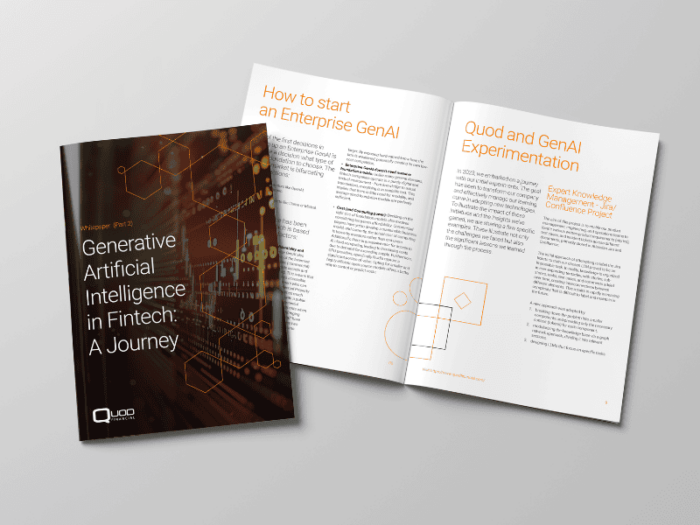
Generative AI is moving fast from experimentation to enterprise reality. For fintech firms building complex, software-driven trading platforms, its impact is less about replacing people and more about unlocking knowledge, removing bottlenecks, and accelerating software delivery.
This whitepaper shares how Quod Financial approaches GenAI today, what we believe comes next, and what we’ve learned through hands-on experimentation.
Executive summary
-
Enterprise GenAI is especially relevant to fintech because much of its value is digital and textual: requirements, tickets, documentation, code, and operational knowledge.
-
The biggest opportunity is activating expert knowledge that is often siloed within a small number of specialists.
-
A “wait and see” approach carries risk. Early experimentation helps organisations build skills, adapt processes, and prepare culturally for change.
-
Quod favours open-source foundation models to reduce confidentiality and IP risks, maintain control over know-how, and manage long-term costs.
-
GenAI adoption should be seen as a holistic transformation programme, not a standalone tool rollout.
Understanding AI today
The paper distinguishes between three major AI domains:
-
Machine Learning (ML) – already widely used in enterprise systems for prediction, optimisation, and pattern recognition.
-
Generative AI (GenAI) – foundation models capable of producing text, code, and structured outputs based on learned patterns.
-
Artificial General Intelligence (AGI) – a longer-term and uncertain concept that goes beyond today’s practical use cases.
The focus of this paper is firmly on GenAI as it exists today, and how it can be applied pragmatically in enterprise software environments.
What’s changing in Generative AI
Several developments are shaping the next phase of GenAI adoption:
-
Larger context windows (tokens) enabling models to process and reason over more information at once.
-
Multi-agent systems, where specialised agents collaborate and validate outputs.
-
Retrieval-Augmented Generation (RAG) to reduce hallucinations by grounding responses in trusted internal data.
-
Improved reasoning and transparency, making model outputs easier to understand and trust.
-
Rising safety and reliability expectations, especially in regulated environments like financial services.
Why Enterprise GenAI matters in fintech
Deep-tech fintech organisations often face a common challenge:
critical knowledge is fragmented across tools, teams, and individuals.
GenAI has the potential to:
-
Make expertise discoverable and reusable
-
Reduce dependency on a few key experts
-
Accelerate onboarding, development, and problem-solving
-
Automate parts of the software development lifecycle
Rather than replacing humans, GenAI acts as a force multiplier for engineering, testing, and operations teams.
Why Quod chose open-source models
Quod’s GenAI strategy prioritises control, security, and sustainability:
-
Reduced IP and confidentiality risk compared to public commercial models
-
Protection of internal know-how, which is a core asset of a trading technology vendor
-
Right-sized performance, as enterprise fintech use cases do not always require massive models
-
Predictable costs and reduced dependence on external pricing models
Quod’s GenAI experimentation
1. Expert knowledge management
Objective: improve access to knowledge stored in Jira and Confluence (tickets, test cases, incidents).
-
Manual labelling did not scale due to the complexity of relationships between issues.
-
The solution combined a knowledge graph (Neo4j) with multi-agent RAG, using both semantic similarity and structured queries.
-
This approach better reflects how knowledge is actually connected in complex software projects.
2. Automated test script generation
Objective: generate Python test scripts for Quod’s internal automated testing framework.
-
Phase 1: script generation and refactoring
-
Phase 2: fine-tuning using tester Q&A interactions
-
Phase 3: reinforcement learning using human feedback
Key lesson: existing code is not always suitable training data — coding practices need to evolve for AI-assisted development.
3. Codebase refactoring and management
Objective: help modernise a large, complex codebase and reduce technical debt.
-
Code is chunked and processed incrementally.
-
Outputs are reviewed by senior engineers before integration.
-
Refactored code is kept separate to maintain control and quality.
This experiment highlighted the need for:
-
Updated coding standards
-
“LLM-oriented” programming practices
-
Strong change management to address team resistance
4. Synthetic data generation
Objective: generate realistic datasets for testing, simulation, and ML training.
-
Real market and client data is expensive, restricted, or difficult to access.
-
GANs are used to generate synthetic data that mirrors real-world behaviour.
-
This reduces reliance on sensitive datasets while enabling richer simulations.
Longer-term vision
Looking ahead, Quod expects:
-
More natural-language interaction with code and systems
-
Stronger multi-agent planning and reasoning
-
Compute becoming a strategic constraint
-
Significant changes in skills, roles, and software engineering workflows
In the near term, experimentation is as much about cultural readiness as technical capability.
Key takeaway
Generative AI is not optional for enterprise fintech.
The organisations that benefit most will be those that experiment early, invest continuously, and treat GenAI as a strategic transformation — not a short-term trend.
-
About Quod Financial
Quod Financial is a multi-asset OMS/EMS trading technology provider focused on automation and innovation - specialising in software and services such as Algorithmic Trading, Smart Order Routing (SOR), and Internalisation of Liquidity. Quod leverages the use of its data-driven architecture to support the demands of e-trading markets by combining AI/ML-enabled decision-making tools and dynamic market access with a non-disruptive approach to deployment. For more information visit: www.quodfinancial.com
Quod Marketing
+44 20 7997 7020
marketing@quodfinancial.com