


- v1.0 Version
- 611 Download
- 1.58 MB File Size
- 1 File Count
- 26th June 2024 Create Date
- 6th February 2026 Last Updated

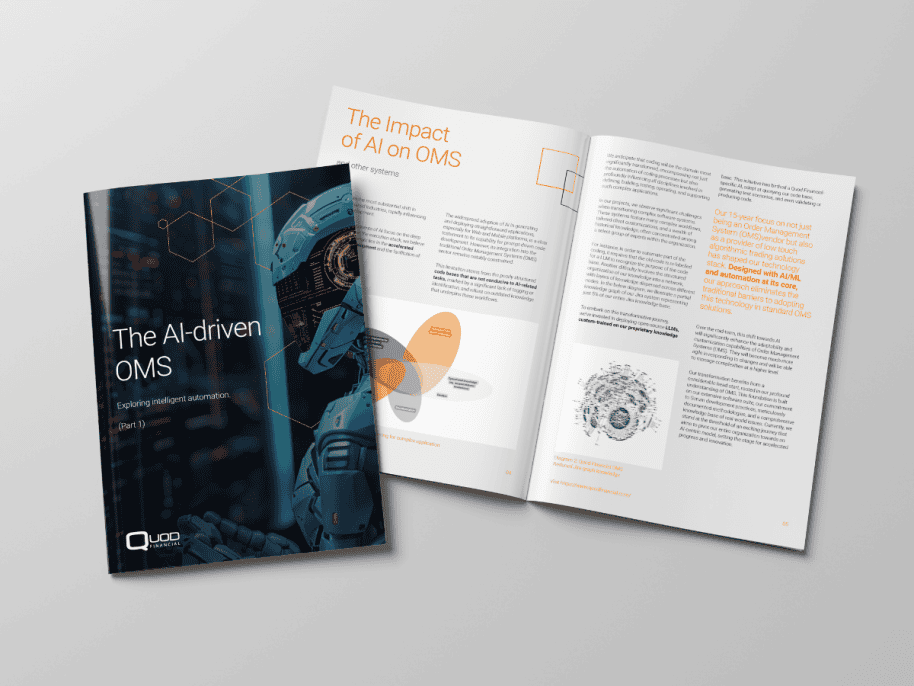
Exploring Intelligent Automation in Modern Trading
Order Management Systems (OMS) have been at the heart of electronic trading for over three decades. Originally designed to enable straight-through processing and cost-efficient execution, most OMS platforms have changed surprisingly little over the last 15 years. Standardisation initiatives such as FIX improved connectivity and automation, but the OMS itself largely remained static — becoming, in effect, the ERP of trading rather than a source of innovation.
As financial markets enter the AI computing era, this long-standing status quo is beginning to shift. For the first time since their inception, OMS platforms are being fundamentally re-examined — not just in how they execute trades, but in how they are built, customised, and evolved.
AI in OMS: Beyond Execution Performance
Much of the industry discussion around artificial intelligence in trading focuses on execution optimisation and algorithmic performance. While these remain important, the more transformative impact of AI lies elsewhere: accelerating OMS development and enabling deep, sustainable customisation.
Modern AI — particularly Large Language Models (LLMs) — can interpret complex workflows, query large knowledge bases, and assist in software development tasks that were previously manual and time-intensive. However, traditional OMS platforms often struggle to adopt these technologies due to legacy codebases, fragmented documentation, and embedded institutional knowledge that exists only in human expertise.
To unlock AI’s full potential, OMS platforms must be structured in a way that allows knowledge, code, documentation, testing, and operational workflows to be connected — enabling AI to work holistically across the system lifecycle.
From Static Systems to Adaptive Platforms
AI-enabled OMS platforms move beyond rigid, hard-coded workflows. Instead, they support continuous adaptation, faster onboarding of new requirements, and easier modification without sacrificing stability.
By structuring OMS knowledge into connected graphs — spanning code, requirements, testing, and operational data — AI can assist with:
-
understanding legacy functionality
-
generating and validating code
-
creating test scenarios
-
accelerating upgrades and client-specific customisation
This approach reduces reliance on a small group of internal experts and makes OMS platforms more resilient, scalable, and future-proof.
Customisation Without Compromise
Historically, OMS customisation often came at the cost of upgradeability. Desk-specific logic, asset-class silos, and bespoke workflows made systems harder to maintain over time.
Modern OMS architectures address this by design. A flexible, multi-asset OMS can support:
-
multiple desks and trading styles
-
diverse asset classes
-
varied order flows and execution strategies
AI and machine learning further enhance this flexibility by analysing historical data, identifying patterns, and supporting predictive decision-making — all while allowing institutions to maintain alignment with their existing front-end tools and operational standards.
Managing Complexity at Scale
As trading strategies become more sophisticated, OMS platforms must support complex, multi-leg orders with precision and efficiency. Advanced OMS solutions enable traders to manage spreads, option strategies, and composite trades within a single, coherent workflow.
Research indicates that executing complex strategies as unified transactions can reduce overall execution costs compared to managing each leg independently. This makes robust multi-leg support not just a functional requirement, but a competitive advantage in modern markets.
Intelligent Automation and Operational Efficiency
Automation has long been a pillar of trading efficiency, but AI introduces a new phase: intelligent automation. By combining AI, machine learning, and robotic process automation, OMS platforms can automate repetitive tasks while adapting dynamically to changing conditions.
From order routing and compliance checks to risk controls and exception handling, intelligent automation reduces operational risk, increases processing speed, and frees trading and operations teams to focus on higher-value activities — without removing human oversight from critical decisions.
Risk, Compliance, and Real-Time Insight
Modern OMS platforms play a central role in risk management and regulatory compliance. Embedded real-time controls and monitoring allow institutions to identify potential risks early, while automated compliance checks help ensure adherence to evolving regulations such as MiFID II and Regulation ATS.
Real-time analytics and reporting further enhance transparency, providing traders and risk teams with actionable insights into performance, execution quality, and market conditions — supporting faster, data-driven decision-making.
The Future of Order Management
The future OMS is not defined by a single feature, but by the combination of:
-
deep customisation
-
support for complex strategies
-
intelligent automation
-
real-time analytics
-
AI-driven adaptability
As markets continue to evolve, OMS platforms that embrace these capabilities will move from being passive systems of record to active enablers of trading performance and operational resilience. In this new landscape, advanced OMS technology is no longer optional — it is foundational to staying competitive.
-
About Quod Financial
Quod Financial is a multi-asset OMS/EMS trading technology provider focused on automation and innovation - specialising in software and services such as Algorithmic Trading, Smart Order Routing (SOR), and Internalisation of Liquidity. Quod leverages the use of its data-driven architecture to support the demands of e-trading markets by combining AI/ML-enabled decision-making tools and dynamic market access with a non-disruptive approach to deployment. For more information visit: www.quodfinancial.com
Quod Marketing
+44 20 7997 7020
marketing@quodfinancial.com